
Barbara Attwood's Story
I was adopted in 1948 during the baby boom after the Second World War, when adopters could walk around orphanages and pick whichever child they wanted. At six months old, my mother took me home to a northern industrial town on the River Mersey, where I felt secure as part of a strong working-class community. As a baby, my mother loved me, but as I grew, her response to my childhood misdemeanours was excessive. Her constant refrain, ‘I don’t know where I got you from,’ began to disturb me. I always felt there was something different about me. She never told me that I was adopted.
At age 12, I found out from a psychiatrist. Learning the secret of my birth from a stranger damaged my relationship with my parents. Forced to offer an explanation, she claimed that my birth mother, Carole, had abandoned me. This crushed any desire on my part to search for my birth mother. My adoption became a shameful secret I was unable to discuss with anyone.
My resentment against my parents coincided with the 60s music scene. On leaving school, I got a job in Liverpool and saw the Beatles at the Cavern Club. I stayed out late, smoked and drank alcohol underage, and frequently returned home drunk. My anger peaked when I attempted to stab my father, and only abated with my marriage and the birth of my first child in 1968.
At age 40, happily married with two teenage children, I became consumed with the need to know who I was. I tried to reassure my family that I loved them. My father confessed that my mother had had a miscarriage before they adopted me, and I wondered if I was compensation. My 80-year-old mother warned me to leave the past alone.
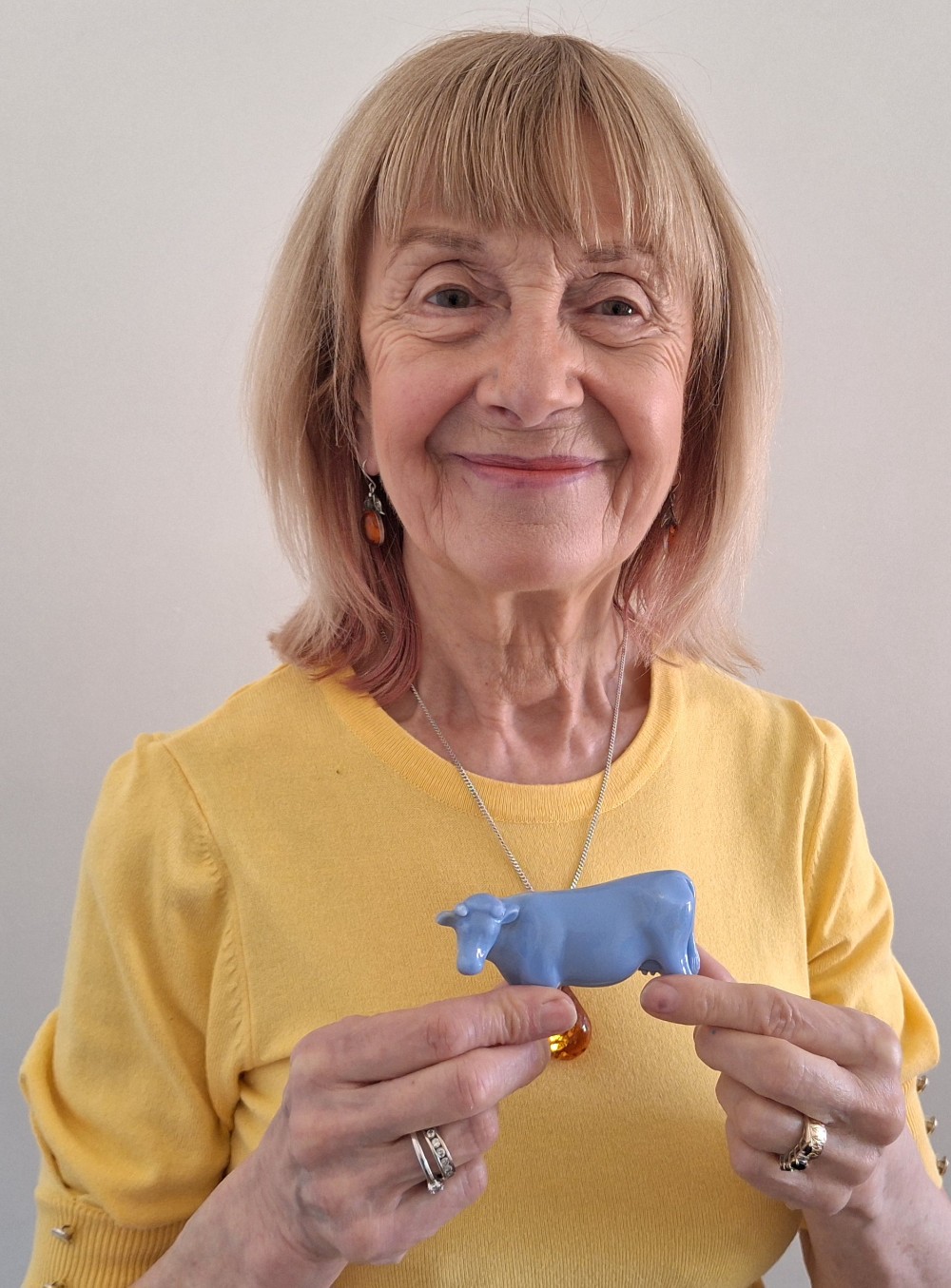
But one day she revealed that, after she adopted me, Carole found out where I lived and my mother had allowed her to visit me until I was nearly four. My mother stopped the visits out of fear that Carole and I were becoming too attached. As a parting gift, Carole gave me a blue plastic cow. Although I never knew its origin, it survived and is still in my possession, hence the name of my memoir, Blue Plastic Cow.
After this second departure from my life, Carole sent my mother letters from Kent, which my mother burned after a teenage argument. She kept four tiny photographs of Carole tending cows on a farm in Kent, but no address. She revealed that, in Carole’s final letter, Carole had said that she was going to Australia with someone she had met in Kent. I wondered if my mother was lying.
After counselling by a social worker, I was given further evidence of Carole’s love in letters written by her to the authorities at the time of my adoption. She had refused to sign the papers on numerous occasions, but with no family support and under the influence of an Irish Catholic priest, she signed.
The 26-year search for Kathryn took my husband, Derick, and me nationwide. There was no Internet or Ancestry to help us. We knocked on doors in the cobbled streets of Colne in Manchester, her last known address. Carole’s exact date of birth was missing from the report, increasing the difficulty as we waded through the ledgers at St Catherine’s House.
She had been a Land Army girl after the war and had met my biological father, Thomas, while working on his father’s farm in Derbyshire. We found no trace of Carole in the area.
In 1988, my husband phoned me at work to say he had located Thomas, my biological father, who lived near his original address. I was doubtful, but he was my only link to Carole, and he agreed to meet me. Walking across his fields, I contemplated how different my life could have been. His mother had planned their wedding. He called it off three days before.
Carole gave birth to me in a workhouse, where I was taken from her at five days old. He didn’t want me in his life and he wouldn’t tell his two daughters that he had an illegitimate child, as he’d brought them up strictly. His admission that he probably would have come looking for me if I’d been a boy infuriated me. I felt rejected again.
We had weekly phone calls, initiated by me. In between rants about politics, his voice would soften as he told me about Carole, each call revealing more. She was from Essex, not Manchester as I had previously thought. During their courtship, he’d gone to the Fens of Essex with Carole to visit her grandmother, where they’d visited a church with no steeple. My search turned south.
Aware she was a Catholic, I contacted a priest in the area, who searched through baptismal records, but found none for Carole. During the search for Carole, I followed every lead. I advertised in newspapers, went on radio, liaised with Australian Social Services, but they found nothing. I applied to go on media programmes that specialised in finding lost relatives, but none were interested, I presumed because I couldn’t guarantee a happy ending.
I accumulated four files bursting with correspondence. My mother died aged 93. I grieved for the woman who had always loved me. But I still had a mother somewhere, and I longed to find Carole.
I went over the files with my husband. I visited the Fens, searching for the places Thomas had recalled. I found a church with no steeple, a convent school she may have attended. I spoke to a ninety-eight-year-old nun and roamed down pathways in fields I imagined she walked as a girl.
In our final telephone conversation, Thomas said that I was conceived in love. He recalled the passion they both felt. His words made sense of my existence. A week later he died. I was filled with regret, but I contacted my half-sisters. They had been unaware of my existence and were shocked at their father’s betrayal. One said she felt too embarrassed to see me because her father had deserted Carole. Eventually we met up and formed a relationship.
The urge to have one last attempt to find out what happened to Carole resurfaced, and I contacted Ariel Bruce, the private detective who does research for Long Lost Family. She admitted that Carole would be tough to find without a date of birth or permanent address, and it could take up to two years.
After three months, Ariel informed me that Carole died in 2006. I was desolate. I would never be able to meet her or tell her how hard I’d tried to find her. I reproached myself for not contacting Ariel earlier. Carole had changed her name at various times in her life and had a different name on her birth certificate.
The sadness I felt was eased with the knowledge that she married and had three daughters in the UK who I contacted and, after much trauma, we had contact. Although I will never get over Carole’s death, I now have five sisters. I would like to use my experience to help other adoptees.